Bog filters
How big should a bog filter be for my pond?
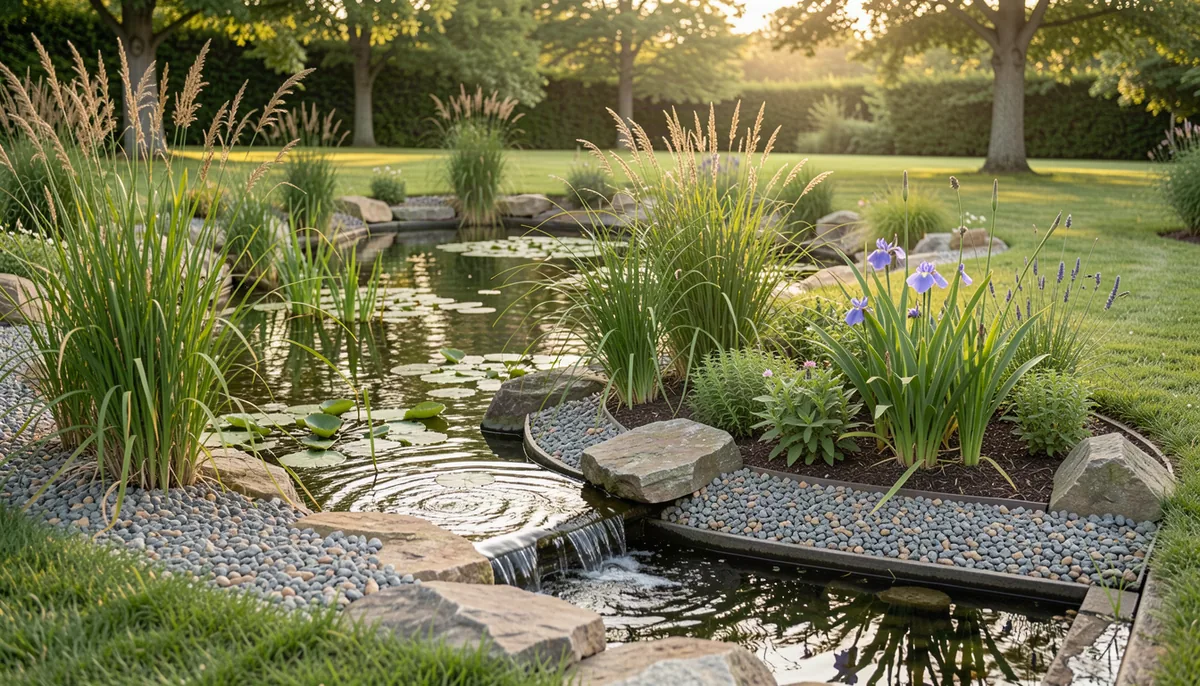
Most published rules make a bog or wetland filter 10 to 20 percent of the pond's surface area for an ecosystem pond or a water garden with a few goldfish, and Nelson Water Gardens says 25 to 30 percent for koi. A 3,000 gallon pond averaging 2 feet deep has about 200 square feet of water, so it needs 20 to 40 square feet of bog at light stocking and 50 to 60 for koi. Fill that 12 inches deep with 3/8 inch pea gravel over slotted 1½ to 2 inch pipe, and pump 1,500 to 3,000 gallons an hour through it.
What the published sources say
No extension service or engineering body publishes a bog size for ornamental ponds. The rules come from builders and suppliers, each for its own design. Aquascape's pages refused our fetches, so its numbers come from dealers that reproduce its tables.
The Pond Guy describes "a separate, smaller pond about 10-20% the size of your pond" and gives no gravel, pipe or flow figures. The International Waterlily & Water Gardening Society (quoted from a search snippet) says a bog "whose surface area is 10% of the surface area of the main pond will suffice, with up to 20% or more for heavy loads."
Nelson Water Gardens in Katy, Texas, publishes the most complete construction guide. It says, "For water gardens 10 - 15% of surface area should be bog, and for koi ponds there should be 25 - 30%." On gravel it says, "use 3/8" pea gravel. Period. End of story," and "you need no more than 12" of gravel substrate." It recommends 1½ to 2 inch pipe, slotted a third of the way through about 1 inch apart, with one line for a bog 2 to 3 feet wide and "additional lines spaced 2'-3' apart" for wider ones, each with a capped clean-out. The pump should "turn the volume of the pond over every 1-2 hours," and "initially you should plant one plant per square foot."
Splash Supply Company, a supplier that sells Aquascape's wetland parts, lists the design guidelines it uses: "A typical constructed wetland on a ecosystem pond would be 15 to 20 percent of the square footage of the pond. In some situations this could be increased to 30 percent." It adds, "Flow rate through each full size centipede should be 2,000 to 3,000 gallons per hour," and layers 5 to 8 inch river rock, then 1 to 3 inch rock, each "typically 8 to 10 inches thick," over AquaBlox.
Aquascape's older Snorkel and Centipede table (reproduced by the dealer Hiner Outdoor Living) starts at a 500 square foot pond with an 8 by 10 foot filter, one Centipede and a 2,000 GPH minimum pump, so the filter is 16 percent of the pond. Its newer FilterBlox table (reproduced by MyPond.ca) is smaller per square foot of pond because the modules hold the media, and its "Filter size reflects components only; surrounding backfill excluded."
The arithmetic for a 3,000 gallon pond
A 3,000 gallon pond holds 3,000 divided by 7.48, or about 401 cubic feet of water. At an average depth of 2 feet that is about 200 square feet of surface. (The 16 by 10 foot basin in our 3,000 gallon pond article is 2.5 feet deep and has 160 square feet, so by these rules it needs a smaller bog.)
| Source and rule | Bog area | Flow through the bog |
|---|---|---|
| The Pond Guy, 10 to 20 percent | 20 to 40 sq ft | not given |
| IWGS, 10 percent, 20 percent or more for heavy loads | 20 sq ft, 40 sq ft or more | not given |
| Nelson, water garden, 10 to 15 percent | 20 to 30 sq ft | 1,500 to 3,000 GPH (pond turned over every 1 to 2 hours) |
| Nelson, koi pond, 25 to 30 percent | 50 to 60 sq ft | 1,500 to 3,000 GPH |
| Splash Supply, ecosystem pond, 15 to 20 percent, up to 30 | 30 to 40 sq ft, up to 60 | 2,000 to 3,000 GPH per full-size Centipede |
| Aquascape Snorkel and Centipede, 16 percent at its smallest row | about 32 sq ft (the table starts at a 500 sq ft pond) | 2,000 GPH minimum for one Centipede |
| Aquascape FilterBlox, 225 sq ft row (next size up) | 18.6 sq ft of modules in an 8 by 5 by 4 foot hole, 20 by 17 foot liner | 1,000 to 1,500 GPH |
The rules agree on 20 to 40 square feet at light stocking. Only Nelson names koi, and its koi bog is about twice that.
Gravel, pipe and plants for that bog
In a bed 12 inches deep, the gravel in cubic feet equals the bog area in square feet. Anchorage Sand & Gravel says a cubic yard of its pea gravel "weighs approx. 2,600 lbs or 1.3 tons," and GravelShop lists 3/8 inch pea gravel at "2,410 lb/yd³," so the tonnage is a range between the two. The flow column applies Ozponds' rule of six bog volumes an hour, counting the whole bed. The liner allows 1 foot of depth and 1 foot of overlap on each side, which is our assumption. Nelson lines its raised bogs with 45 mil EPDM lapped over the walls.
| Bog | Gravel | Plants at one per sq ft | Distribution pipe | Flow at six bog volumes an hour | Liner |
|---|---|---|---|---|---|
| 3 by 10 ft (30 sq ft), light stocking | 30 cu ft (1.11 cu yd), 1.3 to 1.4 tons | 30 | one 10 ft line, 1½ to 2 in, one clean-out | 1,346 GPH | 7 by 14 ft |
| 5 by 12 ft (60 sq ft), koi | 60 cu ft (2.22 cu yd), 2.7 to 2.9 tons | 60 | two 12 ft lines 2½ ft apart, a clean-out on each | 2,693 GPH | 9 by 16 ft |
Both flows land inside Nelson's 1,500 to 3,000 GPH range or just under it. Nelson's plant list includes Japanese and Louisiana iris, dwarf papyrus, corkscrew rush, taro and canna, and it calls all cattails, umbrella palm, parrot's feather, yellow iris and the mints invasive in a bog.
What builders and owners report
John Adams, writing in POND Trade Magazine, uses three 4 to 6 inch layers: 2 to 5 inch stone, then ¾ to 1½ inch stone, then ¼ to ½ inch stone. He wrote, "In our experience, there is no biological filter that outperforms a constructed wetland." Replying to readers, he sized wetlands at "25-30% of the size of the pond surface area," said "as features get larger, the % can get smaller," and warned against pushing "too much water through the filter."
Kev of Ozponds sizes a fish pond's bog at "10-15% of the area or volume of the pond" and a swim pond's at "25% or more." In a second article he accepts any depth from 30 cm to 1.2 meters and aims "for a flow rate of about six times the volume of the bog per hour."
On Garden Pond Forum, addy1 wrote a build guide other members cite. Her bog is "27% compared to the surface area of my pond," fed at "around 4500 gph," which "gives me a every two hour turn over," through 2 inch pipe cut "every 1 to 1.5 inches." She reported, "In the years I had the pond I never cleaned it." In a thread on depth, poconojoe runs 12 inches of pea gravel over "a bit larger than 30%" of his pond's surface. His water "was solid green before starting up the bog. It is now crystal clear." Not every bog works out: koidaddy's top-fed 12 inch bog "looked good up top but down low it was like low tide in the bayou."
Where the sources disagree
Depth is the plainest split. Nelson says "build deeper than 12" and the system can fail," while Aquascape-style wetlands sit 3 to 4 feet deep on a void space of AquaBlox. On Garden Pond Forum, Lisak1 says hers "is four feet deep," but "the gravel bed ends up being only about 1.5 feet deep over the Aquablox," so the gap is smaller than it looks.
Pre-filtering is the second split. Nelson calls a foam pre-filter "Starving the bog," because the plants need the waste. Splash Supply puts a skimmer ahead of the wetland, which it says will "help to remove up to 90 percent of physical debris," and koidaddy came away from his fouled bog doubting the no-pre-filter advice.
The koi pond is where the bog's role changes. In a lightly stocked pond the bog can be the only filter, as it is for addy1. For koi, Nelson raises the bog to 25 to 30 percent, and Kev of Ozponds says "a bog filter alone may not be enough to keep up with the waste." Nelson adds a mechanical filter when a client insists. In that setup, size the mechanical filter, UV and air for the fish as in our koi pond filter, UV and aeration article, and treat the bog as the stage that strips nutrients.
Two numbers circulate without a basis. Pond Informer gives a 10 to 20 percent rule, then says "if you've got a 1,000-gallon pond, you're looking at about 100-200 square feet of bog filter." A 1,000 gallon pond averaging 2 feet deep has about 67 square feet of surface, so that is about 15 times its own rule and larger than the pond. On Garden Pond Forum, Meyer Jordan argued for slow flow from a sewage-treatment wetland rate of "21,000 gallon per day/acre." On a 30 square foot bog that is about 14.5 gallons a day, so a 3,000 gallon pond would take more than 200 days to pass through once.
What to do
- Measure the surface area, decide between a few goldfish and koi, and set the bog at 10 to 20 percent of the surface for the first or 25 to 30 percent for the second. Where space is short, a deeper Aquascape-style wetland fits more media under a smaller footprint.
- For a site-built bog, lay 1½ to 2 inch slotted pipe in lines 2 to 3 feet apart, cap the ends, give every line a clean-out, and cover it with 12 inches of 3/8 inch pea gravel mounded above the waterline.
- Pick a pump that turns the pond over every 1 to 2 hours, and check it against six bog volumes an hour, or 2,000 to 3,000 GPH per Centipede.
- Catch leaves with a skimmer or basket ahead of the pump, but do not put a foam pre-filter in front of a gravel bog.
- Plant one plant per square foot, out of the pots, and leave cattails and the other spreading species out.
The PondTools calculators for this
The PondTools app traces the pond's rim on a satellite or drone photo and gives the surface area every rule above starts from. The PondTools surface-area calculator (also standalone) takes that area in square feet, a water temperature and the kind of fish, and its gas-exchange stocking limit shows whether you are in the light or the koi row. The PondTools volume calculator (also standalone) takes length, width, average depth and a shape and returns gallons. The PondTools pump calculator (also standalone) takes the volume and what the pond holds and returns the target flow; its head-loss section takes the lift, pipe diameter and run up to a raised bog. At the koi setting it asks for 6,000 GPH for 3,000 gallons, more than either bog above should see, so the rest goes through the mechanical filter or the waterfall.
Retrofit check: where the wetland can actually go
On an existing pond, test each candidate position against four site questions before applying any size rule. Aquascape's current modular wetland instructions require incoming prefiltration, a gravity return and an accessible sediment-removal vault. That describes the manufacturer's system, not every planted gravel bog. For its flow, excavation and media figures, use the current component revision. This section gives no sizing rate.
| Check | What to record | Position A (example) | Position B (example) |
|---|---|---|---|
| Return elevation | Outlet height minus the pond water level, same datum | Outlet 8 in above water, fall 8 in | Outlet 1 in below water, fall -1 in |
| Intake | Where prefiltered water enters, and the pipe route | Skimmer or intake bay beside it | Intake across a patio |
| Sediment access | Can someone reach the vault or cleanout with a pump? | Lid on the path side | Behind a retaining wall |
| Planting space | Footprint after excavation, plus liner join to the pond | Open lawn | Tree roots on one edge |
Fall is outlet elevation minus the pond water level: 8 in minus 0 in is 8 in for Position A, and -1 in minus 0 in is -1 in for Position B. This is only an outlet-height comparison. A submerged outlet does not by itself rule out a gravity return: the filter water level, receiving level and return losses matter. Check those with the selected system instructions before accepting either position.
Sequence
- Mark both positions on a scaled plan. In the PondTools app, enter the scale and measured dimensions yourself, since nothing is inferred from a photo.
- Shoot levels for the return elevation at each position and write them on the plan.
- Draw the sediment route first. In one TEAM Aquascape build, a snorkel from the bottom distribution modules allowed pumping out sediment. That was a wildlife refuge project, so treat it as a case, not a rule.
- Set the footprint. TEAM Aquascape laid only the top aqua block panels on the ground to mark the dig, which is a quick way to test space on your own site.
- Plan the liner join. In another TEAM Aquascape project, a wetland dug beside the pond needed a separate liner piece seamed on. Follow the current instructions for the seam. Use the liner calculator only for the sheet size you enter.
- Check pipe head with the pump calculator once the route is fixed. A 3-inch bottom feed belonged to one large pond build, so pick your pipe size from the current instructions.
What a retrofit does not settle
Elevations and access do not prove that a wetland will clear the water or that the filter is sized right. Do not carry an older video's layering to a current system.
Sources
- Gravel Bog Filter Construction, Nelson Water Gardens
- What Is a Bog Filter?, The Pond Guy
- Filtering the Pond with a Bog Garden, International Waterlily & Water Gardening Society (quoted from search snippet)
- Wetland Filtration Using Aquascape Snorkel Centipede, Splash Supply Company
- Snorkel and Centipede Wetland Filter (Aquascape sizing table), Hiner Outdoor Living
- Aquascape Wetland Filters (FilterBlox sizing tables), MyPond.ca
- 3/8" Minus Concrete Pea Gravel, Anchorage Sand & Gravel
- Brown Pea Gravel (3/8") calculator, GravelShop
- Wetland Filtration Offers Simple Path to Clear Water, John Adams, POND Trade Magazine
- Bog Filter Design: What Size?, Ozponds
- How Deep Does a Bog Filter Need to Be?, Ozponds
- Is a Bog Filter a Good Filter for a Koi Pond?, Ozponds
- Bog building, also called upflow filter, eco filter, wetland filter, Garden Pond Forum
- 2 types of DIY bog filters, Garden Pond Forum
- GPH for Bog Filter, Garden Pond Forum
- How to Make a Bog Filter, Pond Informer
- Wetland System Installation Instructions, Aquascape
- Exotic Animal Refuge: Custom Filtration System - Part 2, TEAM Aquascape
- HE Did It AGAIN! Creating A Unique Pond For His Brother, TEAM Aquascape
- Same Layout, Same Materials… Two Completely Different Ponds!, TEAM Aquascape
- LARGEST Stone Staircase Brian Has EVER Built! Texas Recreation Pond Part 4, TEAM Aquascape