Leaks and evaporation
How to find a pond leak, or tell if it is just evaporation
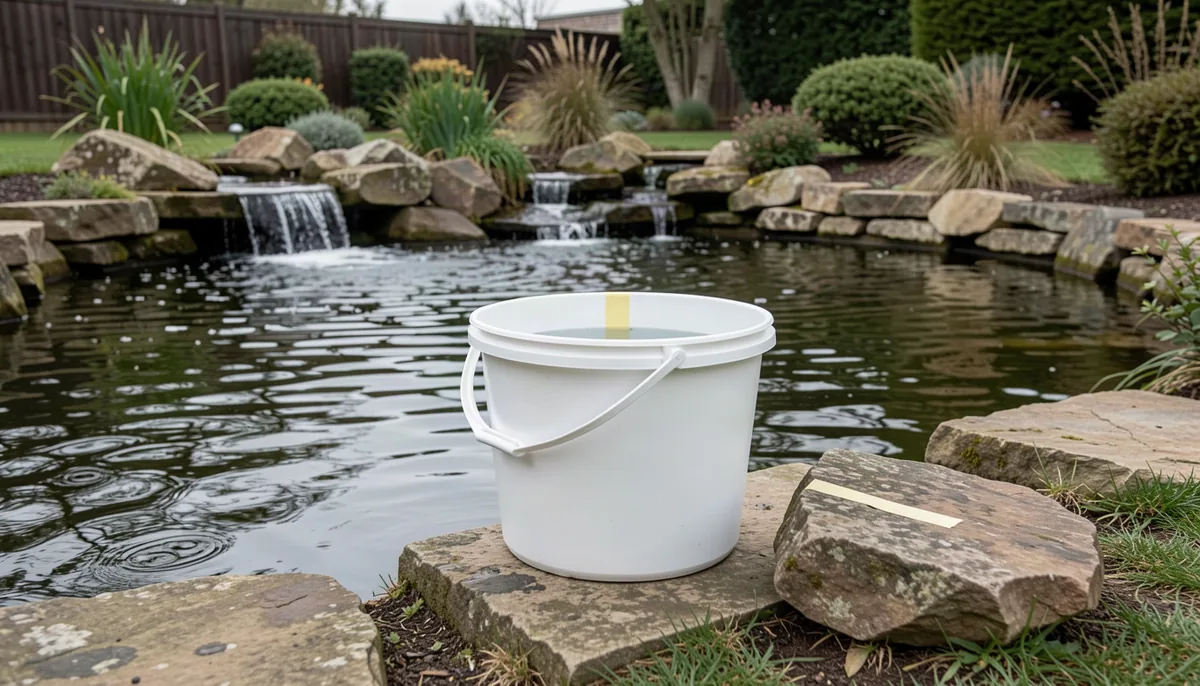
Compare pond and bucket levels against fixed marks, recording weather, pump state and any added water. A pond that drops faster needs inspection, but the difference does not identify the cause. After a pump-off test, wait for the stream to finish draining before marking a new baseline. A level that holds or stops falling narrows the next inspection; it does not prove an exact leak location. Keep the aeration your fish need throughout the test.
What the published sources say
The clearest written bucket test comes from Clemson Cooperative Extension (Molly Jones, January 2026): "Fill a bucket 1-2 inches from the top," set it "on a flat shelf or step inside the pond" 5 to 6 inches deep so it stays at the pond's temperature, mark the water inside and the pond level outside, and "Wait 24-48 hours, leaving the pond undisturbed (do not add any water to the pond during this time)." If the pond "has dropped faster than the bucket, there is a high likelihood of leakage." The page gives a rate too: "Normal evaporation can cause water levels to drop by 0.25 to 0.5 inches per day during hot, dry summer months." Clemson writes for farm ponds, which our article on leaks in earthen ponds covers; the bucket works the same in a lined pond.
Aquascape's page Think You Have a Pond Leak? Don't Panic! refuses automated fetches, so these quotes are from its search snippets. In Phoenix "you can expect to lose up to three to five inches of water every week during the heat of summer," while in the Great Lakes area "you're likely to experience just one to two inches of evaporation each week." With the waterfall off, once the level stops dropping the leak "is immediately at, or just above that level," and if it stops about even with the skimmer opening, "the pond itself is holding water and you probably have a problem with the skimmer faceplate."
The Pond Guy sets the highest ceiling: "In the heat of the summer, it is not uncommon to naturally lose up to an inch of water per day (give or take)." It says to turn the pump off "for a few hours, but leave your aerator running," inspect "your waterfall and skimmer boxes for cracks," and once the level settles, "check the first few inches of the liner above the water surface." EasyPro's how-to sheet now returns an error; its search snippet gives half an inch to three quarters of an inch a day "under certain weather conditions." Pond Trade Magazine is lowest: "most water features will loose approximately 1 inch per week by evaporation."
| Source | As stated | Inches per day |
|---|---|---|
| Pond Trade Magazine | about 1 inch per week | 0.14 |
| Aquascape, Great Lakes (snippet) | 1 to 2 inches per week | 0.14 to 0.29 |
| Meyer Aquascapes, Midwest | 1 to 1 1/2 inches per week | 0.14 to 0.21 |
| Clemson Extension, hot and dry summer | 0.25 to 0.5 inch per day | 0.25 to 0.5 |
| Aquascape, Phoenix summer (snippet) | 3 to 5 inches per week | 0.43 to 0.71 |
| EasyPro (snippet) | 1/2 to 3/4 inch per day | 0.5 to 0.75 |
| The Pond Guy, summer heat | up to 1 inch per day | up to 1 |
What contractors and pond owners do
Meyer Aquascapes in Cincinnati says to "Shut down the pump and leave it for 12 or more hours," because where the level stops "will determine the height of the leak." At the skimmer and the BioFalls it moves a few rocks to "slide you hand behind the liner. Feel for wet soil." On a long stream it runs a garden hose into the course "5 feet from the pond," and if the level holds, moves it "5 feet more up the course." It also claims that "99% of all leaks are not due to a hole in the liner. Settling at the pond's edge is the most frequent cause especially in new ponds." Tussey Landscaping calls edge leaks "the most common cause of water loss," especially in waterfalls and streams, and Iowa Waterscapes adds buried plumbing, animals, roots and "stakes from your recently installed underwater lighting."
On the Garden Pond Forum, in Dreaded waterfall leak (2021), Combatwombat put it simply: "If it's not a hole, then it's the spillway too high or liner edge too low." The owner, Pond Skipper, found something else: "It was definitely just a case of the pond foam creating a little back wash area." In Can't find the leak! (2013), JohnHuff said to "Switch the pumps off to see if it still leaks," and fishin4cars suspected the pressure line to the waterfall; the owner, Cdsdave, never found it and settled for "I'm assuming its somewhere along the liner at that depth." In Pond / Waterfall leaking (2019), Lisak1 suggested "the old milk or food dye in the water," but that leak sat behind a rock wall the owner would not take apart, and the thread ends without a fix.
Where the sources differ and why it matters
The evaporation figures span a factor of seven, from an inch a week to an inch a day, and both ends can be right for different yards. The bucket test sidesteps the argument because the bucket sits in your weather. Its gap is splash: water thrown off a waterfall and soaked into rock evaporates faster than water in a still bucket. Run it once with the pump on and once off; if the pond matches the bucket only with the pump off, look at splash and the stream edges.
Another rule leaves surface area out. Aquascape's support article (snippet) says losses "are typically calculated as 0.5% to 1% of the GPH" of the pump per day, so a pump moving 4,000 GPH after head loss accounts for 20 to 40 gallons a day. Tussey prints the same rule "per hour," yet its own example, 15 to 30 gallons a day for a 3,000 GPH pump, only works per day. The rule estimates what a waterfall adds, but the pond's size and climate set most of the loss, so use it as a rough check.
The level you watch can mislead too. Pond Trade works an example where "1 inch of actual evaporation in the entire system" shows up as "1.6 inches of actual drop in the lower pond," because the stream and upper pool evaporate while you read only the lower pond. A pondless basin exaggerates it further. And when the pump goes off, the stream drains back and the pond rises, so mark the level after that settles.
What a quarter inch a day is in gallons
One inch over one square foot is 0.623 gallons, since a cubic foot holds 7.48 gallons and an inch is a twelfth of a foot. Trace your rim in the PondTools app and it reports surface area from the outline itself; the PondTools surface-area calculator (also standalone) takes that area in square feet, with water temperature, the coldest night and the kind of fish. A traced 3,000 gallon pond with 200 square feet of water (about 2 feet average depth) holds 124.7 gallons per inch, so a quarter inch a day is 31.2 gallons a day, or 218 gallons a week. A 1,000 gallon pond of about 80 square feet loses 12.5 gallons a day at that rate, and a 20,000 gallon pond of about 1,000 square feet loses 155.8. Judge a leak by inches, which are the same at every size, and use gallons for the autofill and the water bill.
| Drop per day | 200 square feet (about 3,000 gallons) | 550 square feet (about 10,000 gallons) |
|---|---|---|
| 1 inch per week (0.14 inch per day) | 17.8 gallons | 49.0 gallons |
| 1/4 inch | 31.2 gallons | 85.7 gallons |
| 1/2 inch | 62.3 gallons | 171.4 gallons |
| 3/4 inch | 93.5 gallons | 257.1 gallons |
| 1 inch | 124.7 gallons | 342.9 gallons |
An autofill hides a leak, so turn it off for the test or read its meter. After a leak has drained several inches, the PondTools volume calculator (also standalone) takes length, width, average depth and a shape factor and returns the pond's volume, so you can see what share you are replacing with tap water and dose dechlorinator for it.
What to do
- Turn off the autofill or record its additions, wait for dry weather, and compare pond and bucket readings. Similar drops are consistent with evaporation under those conditions; they do not rule out every leak.
- If the pond falls faster, top it up and turn the pump off for 12 hours or more, keeping an aerator running for fish. Mark the level once the stream has drained back.
- If the level holds with the pump off, search the stream, waterfall and plumbing: walk the stream edges for wet soil and settled liner, feel behind the liner at the BioFalls, check the fittings, and use the hose in 5 foot steps on a long stream.
- If the level falls and stops, inspect the perimeter near that line and the skimmer faceplate, without assuming either is the fault. Correct a low edge, seal or hole only after locating the loss, using compatible materials and installation instructions (see EPDM against RPE).
- If it keeps falling, protect the fish and investigate further. A lower liner fault or bottom-drain connection is one possibility; arrange the holding and inspection plan before draining the pond.
Do not pour sealant in hoping it finds the hole, and do not pull rock off the liner until the pump-off test has told you which part of the system to search.
Pump-off log: running, stopped, restarted
A stopped level is a clue, not a verdict. Log three phases, with the autofill off or its meter read, so evaporation, drain-down and loss can be separated. The Pond Guy recommends maintaining aeration during a pump-off test. Allow stream drain-down to settle before choosing the stopped baseline, and preserve the aeration your fish need.
Record for each reading: clock time, pump state, aerator state, autofill meter, level below a fixed reference mark, bucket level and weather. The rows below are an illustrative example for a 200 square foot pond, not a real job.
| Phase | Time | Pond below mark | Bucket drop so far | Note |
|---|---|---|---|---|
| Running | 8:00 | 1.00 in | 0 | Mark both levels |
| Pump off, draining back | 9:00 | 0.75 in | 0 | Do not use this reading |
| Pump off, settled | 11:00 | 0.75 in | 0 | Baseline |
| Pump off, end | 20:00 | 1.00 in | 0.10 in | Pond fell 0.25 in in 9 hours |
| Restarted, settled | 21:00 | 1.25 in | 0.10 in | Stream refilling |
The 0.25 inch pond drop is about 31.2 gallons (200 square feet x 0.25 in / 12 x 7.48 gallons per cubic foot). Subtracting the bucket's 0.10 inch leaves a comparison gap of 0.15 inch, about 18.7 gallons. A still bucket does not reproduce waterfall splash or every evaporating surface. That gap says to keep looking, not where the loss is.
Inspect in a fixed order
- Skimmer faceplate and seal, then the waterfall or BioFalls seal.
- Stream edges, following the water downhill for low spots.
- Fittings and visible plumbing.
- Liner just above the settled waterline.
In a TEAM Aquascape video, the speaker's experience was to suspect low edges and seals first, yet that job ended with a hole. In another, a leaky edge showed up when the waterfall first ran, before burying.
When the result stays inconclusive
- A level that holds with the pump off does not clear the pond. Aquascape's BioFalls manual says water can seep through foam when pumps are off, so foam is not evidence of a sound liner.
- A fall that stops can still involve more than one cause, for example a low edge plus evaporation. Compare against the bucket.
- Saturated ground complicates inspection. On one TEAM Aquascape install, the crew's unconfirmed hypothesis was water travelling between liner and soil.
After any repair, repeat the same log under similar weather and compare the pond-minus-bucket gap, not the raw drop.
Sources
- Leaking Ponds: Causes and Troubleshooting, Clemson Cooperative Extension (Molly Jones, 2026)
- Think You Have a Pond Leak? Don't Panic!, Aquascape (quoted from search snippets; the page refuses automated fetches)
- Evaporation: How much water could be lost due to evaporation per day?, Aquascape support (quoted from the search snippet)
- How to Find and Fix a Leak, The Pond Guy learning center
- Diagnosing Water Loss... Is it a Leak or Evaporation?, EasyPro Pond Products (quoted from the search snippet; the file now returns an error)
- Evaporation in Ponds, Streams, Waterfalls and Fountains, Pond Trade Magazine
- Troubleshooting Leaks in Your Pond or Pondless Waterfall, Meyer Aquascapes
- How To Fix Pond and Waterfall Leaks: Follow These 5 Steps, Tussey Landscaping
- Pond Leak or Evaporation? Identify Water Loss Causes, Iowa Waterscapes
- Water Loss in Backyard Ponds: Understanding Evaporation vs. Leaks, Superior Ponds
- Dreaded waterfall leak, Garden Pond Forum (2021)
- Can't find the leak!, Garden Pond Forum (2013)
- Pond / Waterfall leaking, Garden Pond Forum (2019)
- Signature Series BioFalls instructions, Aquascape
- WHERE in the WORLD is THE POND GUY?!, TEAM Aquascape
- A *SMALL WATERFALL* Can Fit Anywhere!, TEAM Aquascape
- What Happens To Expensive Koi Fish?, TEAM Aquascape