Pondless waterfalls
How big should a pondless waterfall basin be?
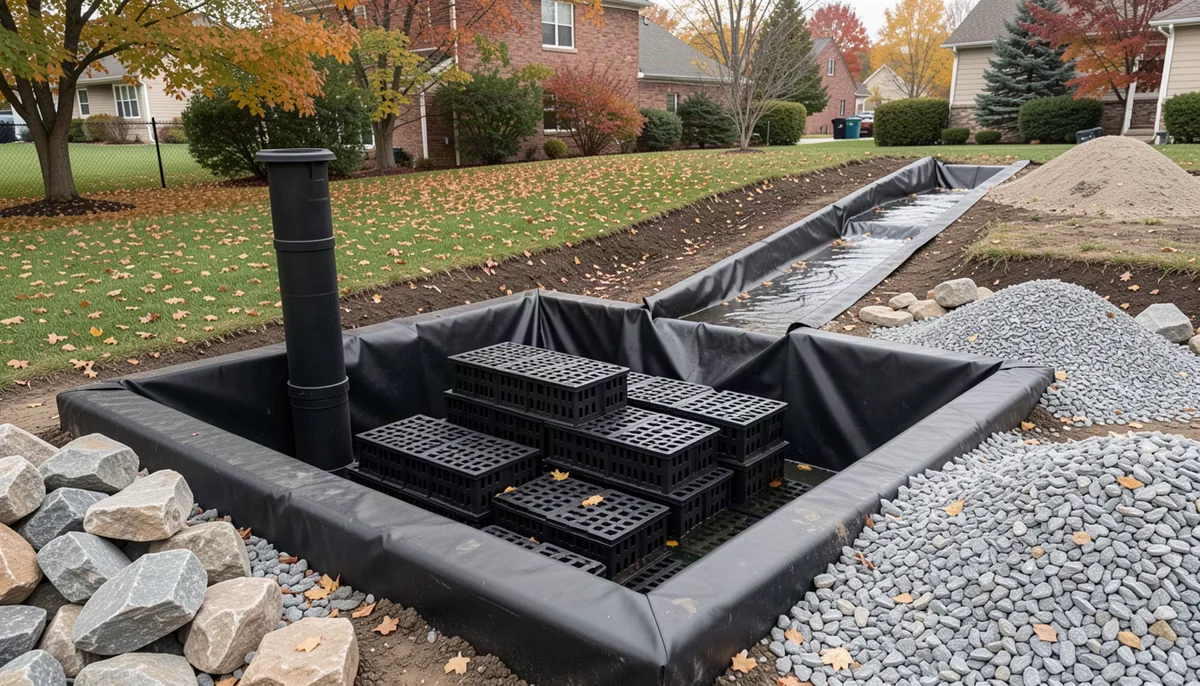
A pondless basin is big enough when it passes two tests. The water left after the stream fills must still cover the pump, and there must be free space for everything that drains back when the pump stops. Gross excavation volume answers neither question. The worksheet below uses invented inputs, so replace each one with your own measurement or with the figure from your selected product's instructions.
Four volumes that get mixed up
- Gross excavation: the hole or block footprint times its height.
- Storage voids: the part of that space that holds water. For blocks, use the manufacturer's rating for the model, not the block's outside dimensions.
- Usable operating volume: water between the lowest level the pump tolerates and the highest running level you set.
- Shutdown free space: room between the running level and the point where water would leave the basin. It must take the drain-down. Additional storm headroom sits above it; replacement-water reserve sits in the operating band.
Convert inches before you multiply
For gallons from a flat area and a depth in inches: square feet, times inches, divided by 12, times 7.48052. For 40 square feet at 1 inch, that is 40 × 1/12 × 7.48052 = 24.9 gallons. The Pond Guy's published example enters a stated inch depth through a 0.25 term, not a division by 12. Do not copy that step. Multiples of stream volume are rules of thumb, and they inherit any unit error in the stream figure.
Other published rules also differ. One contractor sets the basin at a multiple of stream volume (California Aqua Pros), and another ties volume to fall height (Meyer Aquascapes). Forum builders describe the stream's startup fill as water the basin must be able to receive again at shutdown (Garden Pond Forum). That last idea is the one the worksheet measures.
Worked example with illustrative inputs
Assumed: a stream 20 feet long and 2 feet wide, with an effective water-volume depth of 1.5 inches. This assumed depth already accounts for stone displacement and water retained among the stone; it is not the physical rock-bed depth. A spillway box holds 5.0 gallons, a figure you would measure. Pipe is 30 feet with a 2 inch inside diameter and the example assumes the entire pipe empties on shutdown. Actual drain-back depends on pipe geometry and the valve arrangement.
| Item | Arithmetic | Result |
|---|---|---|
| Stream channel | 20 ft × 2 ft × 1.5 in ÷ 12 = 5.0 cubic feet, × 7.48052 | 37.4 gal |
| Spillway box | Assumed measured value | 5.0 gal |
| Pipe that empties | π × (1 in ÷ 12)² × 30 ft = 0.654 cubic feet, × 7.48052 | 4.9 gal |
| Drain-down estimate | 37.4 + 5.0 + 4.9 | 47.3 gal |
Assumed basin: six blocks, each 2 ft × 1.5 ft × 1.5 ft and rated at 28 gallons, in a single layer. Retail listings state a per-block rating, so confirm the figure for the model you buy (for example, Underwater Warehouse's listing). The 6 inch lowest pump level and the 18 inch overflow level are also invented. Aquascape publishes model-specific vault instructions, so take real operating levels from the document for your model.
| Item | Arithmetic | Result |
|---|---|---|
| Gross excavation | 6 × (2 × 1.5 × 1.5 ft) = 27 cubic feet, × 7.48052 | 202 gal as open water |
| Storage voids | 6 × 28 gal; 168 ÷ 202 | 168 gal, 83% of gross |
| Water per inch of level | 168 ÷ 18 in, assuming even voids | 9.33 gal per inch |
| Drain-down as level | 47.3 ÷ 9.33 | 5.07 in |
| Additional storm headroom | Assumed 1 in × 9.33 | 9.3 gal |
| Highest running level | 18 − 1 − 5.07 | 11.9 in |
| Usable operating volume | (11.9 − 6 in) × 9.33 | about 55 gal |
The point of the table: a running level of 14 inches looks comfortable, but at shutdown it would rise to 14 + 5.07 = 19.1 inches, past the 18 inch overflow. Checked in gallons, 4 inches of free space holds 37.3 gallons against a 47.3 gallon drain-down. The basin holds 168 gallons, nearly four times the drain-down, and still fails when the level is set too high. If an autofill sets the running level, the float must sit at or below the highest running level. The worksheet also assumes voids are even over the height, which a vault, cover rock or pipe runs will change.
Plan, then commission
- Lay out the basin. In one bubbling-stream build, TEAM Aquascape used the top of the block panels to mark the reservoir outline before stripping turf.
- Place the vaults with the finished surface in mind. In one pondless build, TEAM Aquascape set two vaults side by side after considering a patio, steps and the boulder layout on top.
- Plan the liner edge for splash. In a fountain install, TEAM Aquascape described liner reaching well beyond the basin so splash rolls back in. No size was given, and the caption wording is uncertain.
- Decide the plumbing before you count drain-back. One TEAM Aquascape build with no biofilter used a union and no check valve, and left hand room around the pump. Check valve choice depends on the system, so count only the pipe that actually empties.
- Run the worksheet with your measurements and the vault levels for your model. Redo it if any input changes.
- Start-up test. Fill to the planned stopped level, then start the pump. In this example, a stopped level of 16.97 inches would fall about 5.07 inches to the 11.9 inch running level. Note both against a fixed mark. Record the level once the stream is full. Compare the drop with the predicted 5 inches in the example, using your own prediction. Watch the level through the start and stop the pump if it nears the manufacturer's minimum.
- Shutdown test. Stop the pump, wait until the stream stops draining, and record the level. Compare the rise with the prediction and with the room left below the overflow. Note whether an autofill added water, because added water hides loss.
- Controlled level change. Lower the level by a known volume, for example 10 gallons, which is 1.07 inches in the example basin (10 ÷ 9.33). Restart, confirm the pump runs with the level above its minimum, then stop and confirm the headroom again.
Keep the liner untrimmed through these tests. Aquascape's pondless manual says to leave liner untrimmed until the basin is filled and the waterfall is running. Also look for wet ground outside the liner. The BioFalls manual says water can seep through foam when pumps are off, so foam does not make a path watertight or structural.
A level that settles lower than predicted calls for a check of the assumptions, water retained upstream, autofill activity and possible loss. It does not locate a fault. A retailer warns that a pump can run dry and overheat if the level drops below its intake (Pond Pro Direct), which is why the lowest level in the table matters. A maker of a competing chamber argues that water held above the pump is what counts (Russell Watergardens), That is a claim about its chamber design; it does not prove that other basin layouts lack usable water.
Flow rate and head choose the pump, not the basin. The pump calculator covers that side, and the volume calculator can cross-check gross excavation from your own dimensions. For the wider build, see building a waterfall and stream.
Sources
- Calculate Basin Size for a Pondless Waterfall, The Pond Guy
- Pondless waterfall installation manual, Aquascape
- Signature Series BioFalls instructions, Aquascape
- Pondless Vault Instructions (49000, 49001), Aquascape
- IF YOU BUILD IT... THEY WILL COME! Bird Loving Stream, TEAM Aquascape
- Rainfed BACKYARD POND & Oasis Build Part 1, TEAM Aquascape
- Easy DIY FOUNTAIN Installs for Any Outdoor Space, TEAM Aquascape
- SMALL BACKYARD WATERFALL in the Woods Finished, TEAM Aquascape
- Aquascape AquaBlox Water Storage Module, Large, Underwater Warehouse listing
- Pondless Waterfall Water Volume Calculations, Russell Watergardens
- Auto Fill Valve Kits for Ponds and Pondless Waterfalls, Russell Watergardens
- Pondless Waterfall Kits: The Complete Buyer's Guide, Pond Pro Direct
- Pondless Waterfall Flow Rates, California Aqua Pros
- Pondless Waterfall Reservoirs Q&A, Meyer Aquascapes
- Basin sizes for stream/waterfall feature, Garden Pond Forum (2017)
- How do I calculate the number of gallons in my Pondless Waterfall?, Aquascape support